MENUMENU
MENUMENU
MENUMENU


Choosing a sewer jetter usually starts with a simple question: what kind of lines does your crew clean most often?
A plumbing contractor working primarily on residential and commercial drains has different equipment needs than a municipality maintaining sewer mains throughout a community. Pipe size, access, the material you’re trying to remove, and how much ground the crew covers in a day can all affect which jetter makes sense.
Pressure and flow are important, but they’re only part of the decision. Water capacity, hose size and length, equipment configuration, maneuverability, maintenance access, and long-term reliability all affect how well a sewer jetter fits the work.
For municipalities, plumbers, drain cleaning companies, and contractors comparing equipment, looking at those factors together is a better place to start than simply choosing the highest pressure or flow available.
Before comparing equipment specifications, look at the work your crew handles regularly.
A plumber may spend most of the week clearing smaller residential and commercial drain lines. A contractor may encounter a broader mix of pipe sizes and access conditions from one customer to the next. Municipal crews may need a jetter capable of working farther into larger sewer mains.
Those differences affect everything from pump output to hose diameter and water capacity.
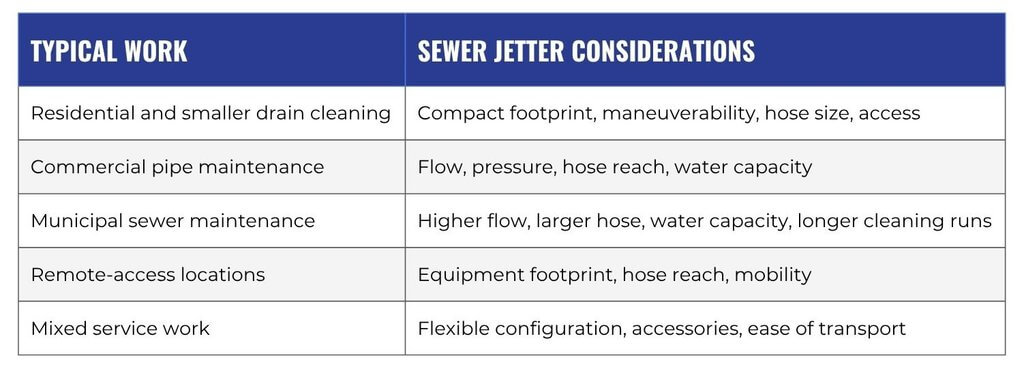
It also helps to account for recurring jobs outside the crew’s typical workload rather than sizing equipment around the smallest or easiest lines alone.
PSI tends to get a lot of attention when people compare sewer jetter equipment. It matters, but pressure by itself doesn’t tell you how a machine will perform in a particular line.
Pressure provides cleaning force at the nozzle. Flow, measured in gallons per minute (GPM), supplies the volume of water available to carry loosened material through the pipe. The right balance depends on factors including pipe diameter, the material being removed, hose size, and nozzle selection.
Within the Mongoose Jetters lineup, the Model 123 operates at 12 GPM and 3,000 PSI, the Model 184 at 18 GPM and 4,000 PSI, and the Model 254 at 25 GPM and 4,000 PSI. The increase in flow corresponds with equipment designed for progressively larger main-line applications. The Model 123 is listed for main lines up to 8 inches, the Model 184 for lines up to 12 inches, and the Model 254 for lines up to 24 inches.
Pipe diameter shouldn’t be the only selection criterion, but these differences show why flow and pressure need to be considered in the context of the cleaning application.
Pump performance determines how water reaches the line. Tank capacity determines how much water the crew can bring to the job.
That becomes important when crews spend significant time jetting between available water sources. Available water capacity affects how long a sewer jetter can continue cleaning before the tank needs to be refilled.
The Mongoose lineup reflects those differences. The Model 123 uses 150- to 200-gallon configurations, while Model 184 configurations range as high as 600 gallons. Model 254 configurations are available with 300- to 600-gallon capacities.
The right capacity depends on how long crews typically jet, where they can refill, and the environments where the equipment needs to work.
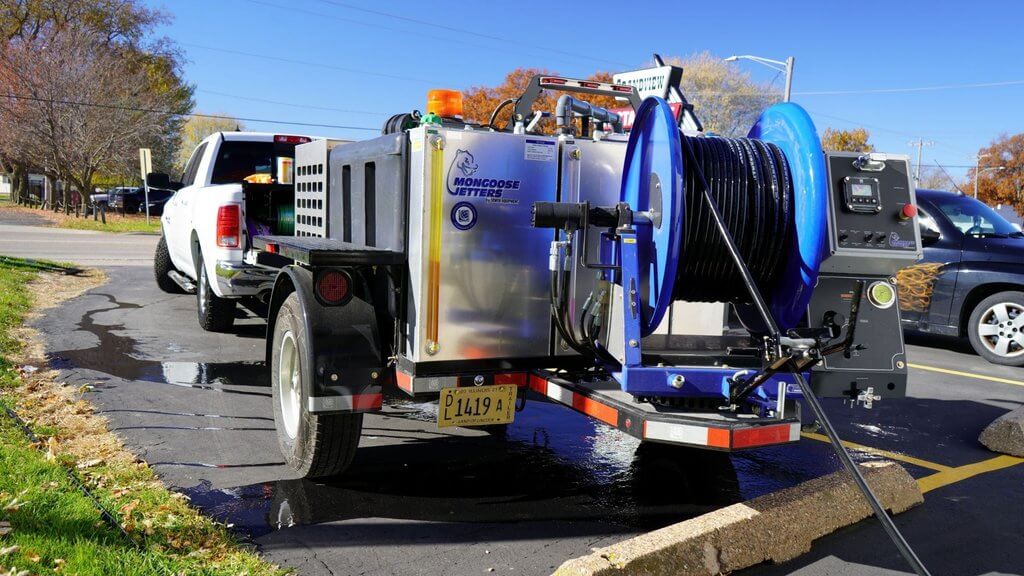
The way a sewer jetter is mounted can have just as much impact on day-to-day use as its pump specifications.
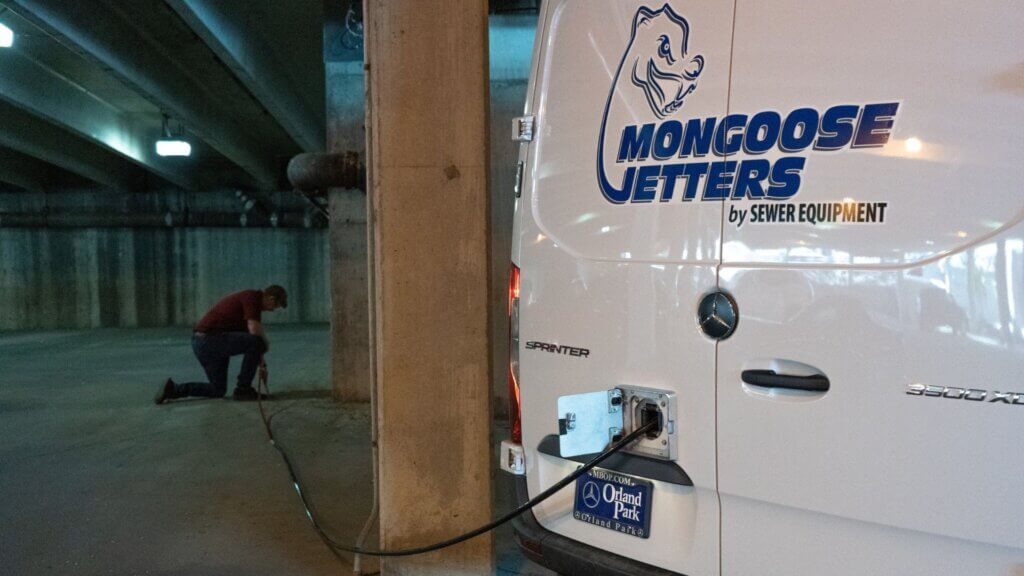
Mongoose sewer jetters are available in multiple configurations across the lineup. The Model 123 can be configured for trailer, truck, and van applications, while the larger Model 184 and Model 254 families include trailer and vehicle-mounted options.
The best choice depends on how the crew gets to the job, where the equipment needs to fit, and whether the jetter will stay with one vehicle or move throughout the fleet.
The pump gets most of the attention, but hose size, hose reach, and nozzle selection also need to match the work.
The Model 123 has capacity for 250 feet of 3/8-inch hose. Model 184 configurations use 1/2-inch hose with 600-foot capacity, with 1,000-foot and dual-reel options available on certain configurations. The Model 254 uses 5/8-inch hose with 500-foot capacity, with an 800-foot option and dual-reel configurations available.
Nozzle selection changes with the job too. A crew trying to penetrate a blockage has a different objective than one flushing loose material through a line. Mongoose equipment includes flushing and penetrating nozzles across the models shown in the full-line catalog, along with additional specialty nozzle options. Mini drain kits and drain-cart configurations are also available for certain models.
Pump performance, hose diameter and length, nozzle selection, and pipe size all need to make sense as a complete setup.
More capacity and higher flow can be useful, but crews still have to get the equipment where the work is.
Residential neighborhoods, alleys, commercial properties, parking areas, and remote access points can all make equipment size and positioning important. For plumbers and contractors moving between several customer locations each day, those considerations can have a noticeable effect on how efficiently crews work.
Before selecting a sewer jetter, consider where it will be parked, what will tow or carry it, and how easily operators can reach the access points they encounter most often.
A sewer jetter spends its working life around water, road conditions, changing temperatures, and demanding cleaning environments. How easily crews can maintain the equipment matters long after the initial purchase.
Operators and mechanics need access for routine service, component inspections, seasonal preparation, and troubleshooting. The Mongoose 123, 184, and 254 families use run-dry pump designs, and the catalog lists air-purge systems across the primary configurations. Several models also offer winterization equipment, with water heater options available on certain larger configurations.
For a municipality or contractor planning to keep a sewer jetter for years, parts availability, technical support, operator training, and the ability to service equipment locally also belong in the buying decision. For long-term ownership, those service and support considerations can be just as important as the specifications on the machine.
Once the application is clear, comparing individual models becomes much easier.
The Mongoose sewer jetter lineup includes options for residential, commercial, municipal, and industrial pipe maintenance, with several levels of pump performance, water capacity, hose size, and equipment configuration.
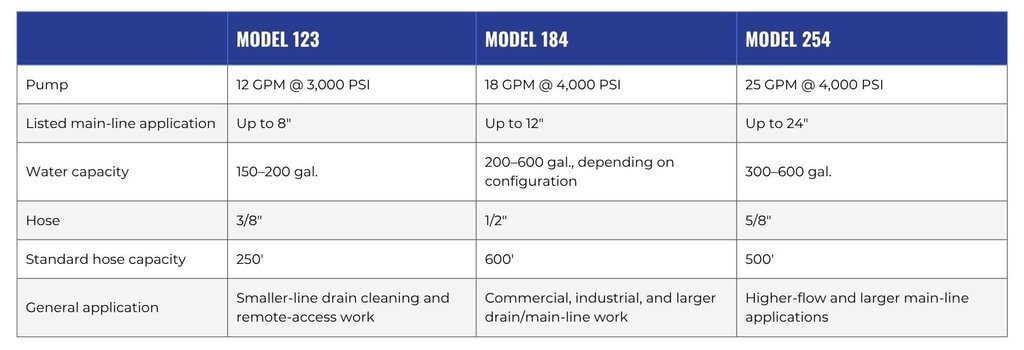
The Model 123 sewer jetter sits at the compact end of the lineup and is suited to smaller-line drain cleaning, remote-access locations, commercial work, and main lines up to 8 inches.
The Model 184 sewer jetter gives crews more flow and capacity for commercial and industrial applications, remote-access work, drain cleaning, and main lines up to 12 inches.
The Model 254 sewer jetter is designed for crews that regularly need higher flow and work in larger lines. Its listed applications include commercial and industrial cleaning and main lines up to 24 inches.
The final setup still depends on the specific work being performed, including access, water requirements, hose reach, and the options the crew needs.
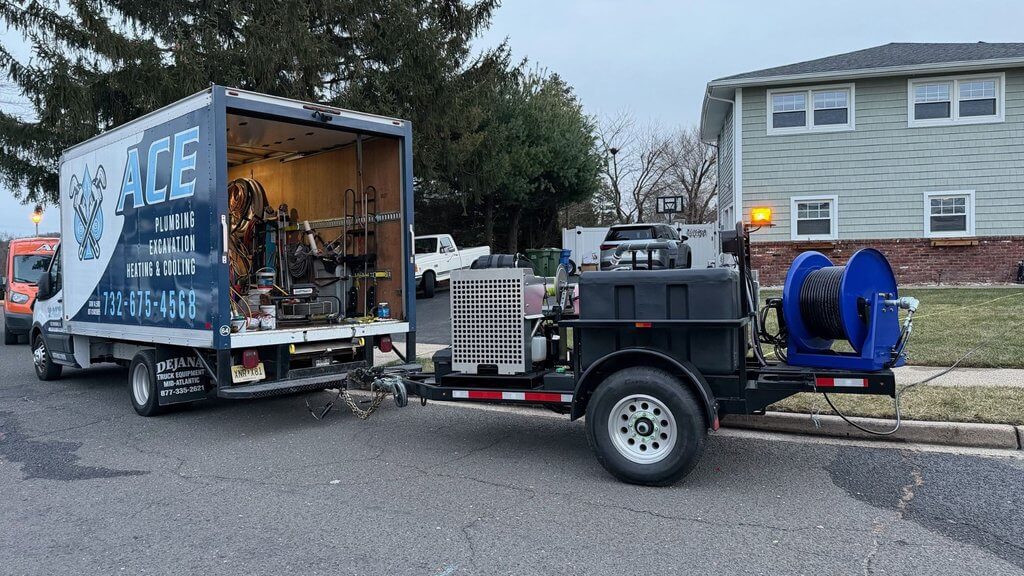
The right sewer jetter is the one that fits the lines, access conditions, routes, and maintenance demands your crew deals with regularly.
Mongoose Jetters are available in trailer, truck, and van pack configurations with options for plumbing and drain cleaning companies, contractors, municipalities, and industrial crews. If you’re comparing the Model 123, Model 184, Model 254, or another configuration, a local Sewer Equipment representative can help match the equipment to the work your crew performs.
